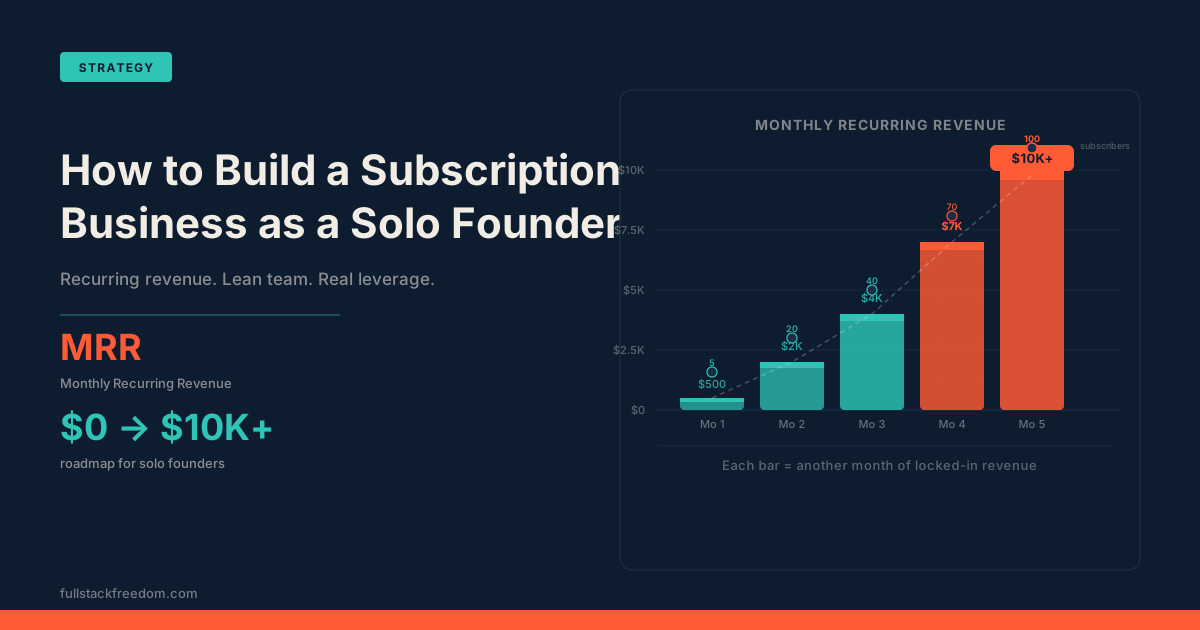
The subscription business model might be the closest thing to a real asset a solo founder can build. Not a job, not a project, but an actual business that pays you while you sleep. That said, most of the advice out there is written for funded teams, not someone building alone at 10pm after their day job.
So let me give you the version I wish I’d had.
Why Solo Founders Should Care About Recurring Revenue
Here’s the painful truth about project-based work: you finish one thing, then you start over. Every month is a zero. You’re on a treadmill, skilled enough to stay on it, but never quite ahead of it.
Recurring revenue changes that math permanently. Even modest MRR compounds over time. A solo founder hitting $5K MRR has something most freelancers never build: predictability. You can plan. You can breathe. You can say no to bad clients.
The numbers back this up. The subscription economy sits somewhere between $575B and $722B in 2025, growing at 13-16% annually and projected to hit $1.2 trillion by 2030. I’m not citing this to hype you up. I’m citing it because the market is large enough that niches inside it are still enormous. You don’t need a big slice. You need a small, defensible one.
The Honest Reality Check
Before you get excited, let me share the numbers that don’t make it into the “build a SaaS” YouTube thumbnails:
- 70% of micro SaaS businesses never reach $1K MRR
- 50% of those that do hit a ceiling between $1K and $10K
- The average time to $1K MRR is about 9 months
That’s not meant to discourage you. It’s meant to help you set honest expectations and pick the right model for where you actually are, not where you want to be.
Here’s what $1K, $5K, and $10K MRR actually means in practice:
| Milestone | Customers | What It Proves |
|---|---|---|
| $1K MRR | 20–30 | Product-market fit is real |
| $5K MRR | 60–100 | Covers basic living expenses |
| $10K MRR | 100–200 | Sustainable solo income |
The good news: 95% of subscription businesses that survive past the early stage reach profitability within 12 months. Survive is the operative word.
The Four Models That Actually Work Solo
Not all subscription businesses are created equal for a one-person operation. These are the four paths I see work consistently, each with a different profile of skills, starting conditions, and time horizon.
1. White-Label SaaS
This is the fastest path to recurring revenue if you already have clients. You license an existing platform under your own brand and resell it. No code required, no product team, no infrastructure headaches.
GoHighLevel SaaS Mode is the most common example in the marketing/agency space. You build a branded product on top of their infrastructure and charge clients monthly for access. Your margin is the spread between what you pay and what you charge.
The catch: you’re dependent on the platform. If they raise prices, change features, or go down, that’s your problem. You’re also limited to their roadmap. For most solo founders, this is an acceptable tradeoff. You’re buying speed, not equity.
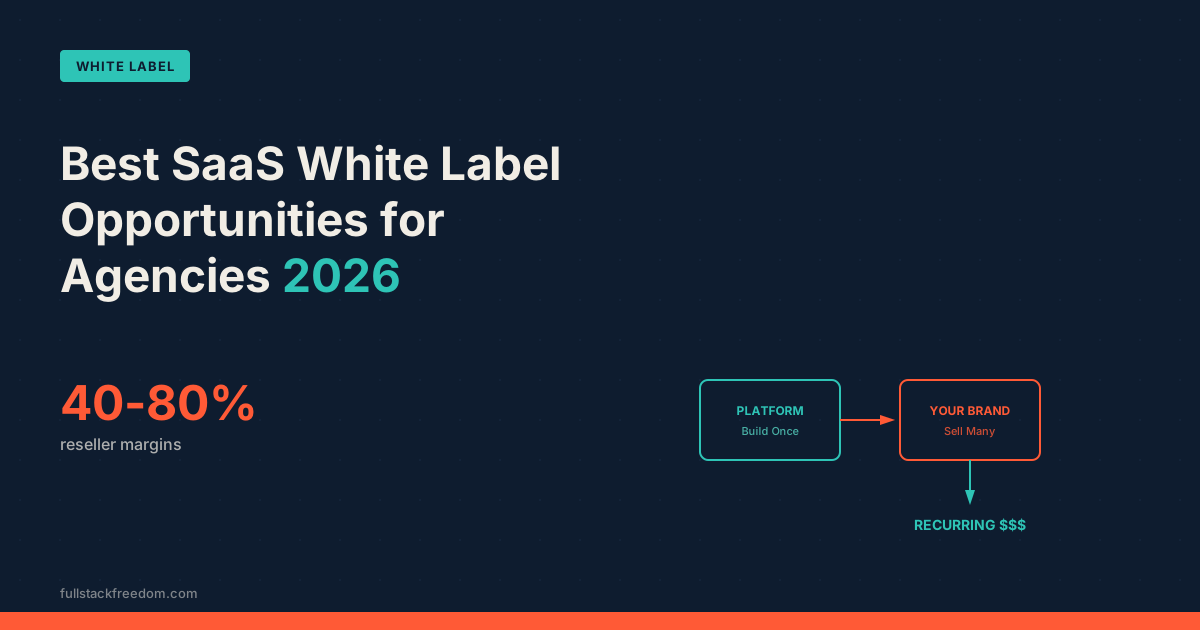
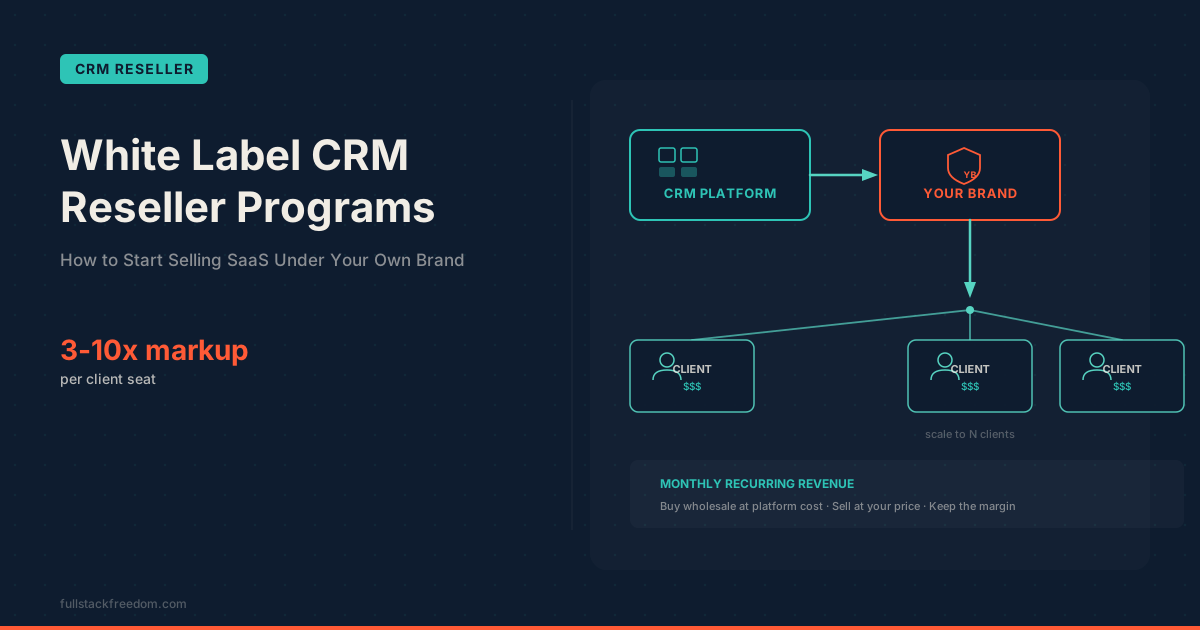
If you want to go deeper on specific platforms and programs, I’ve written about best SaaS white label opportunities for agencies in 2026 and the best white label CRM reseller programs worth considering.
2. Content and Community Memberships
This model runs on audience first. If you have followers, readers, or a community (even a small, engaged one), you can monetize with recurring access to content, a private community, or both.
The platforms to know:
- Skool: Flat $99/month, you keep all the revenue. Best for tight-knit communities with live engagement.
- Substack: Takes 10% of paid subscription revenue. Strong for writers and thought leaders with existing email traction.
- Patreon: Also 10% cut, creator-focused, strong for ongoing content drips.
- Beehiiv: Solid for paid newsletters if you prefer that format.
The real moat here is trust, not content. People pay for proximity to a person they believe in, or a community that accelerates their goals. The content is the proof of value, not the product itself.
The platform decision is largely secondary to the audience question. If you don’t have an audience yet, this model requires building one before monetizing, typically 6-18 months.
3. Productized Services
This one flies under the radar but has produced some of the most impressive solo founder results I’ve seen.
The model: fixed scope, fixed price, recurring monthly billing. You’re not selling hours. You’re selling an ongoing outcome, packaged so tightly that delivery becomes predictable.
Brett Williams of DesignJoy is the poster case: $4,995 to $7,995/month plans, reportedly $1.3–2M per year as a solo operator. 180Sites built a website subscription at $950K ARR. Neither required building software.
What makes this work solo is that the product is the process. You define what’s included, cap the scope ruthlessly, and deliver it the same way every time. Scope creep is the enemy, and you have to be willing to say no to custom requests.
The ceiling is real: support and delivery complexity hits a wall around 100-200 active clients depending on your service type. Most solo founders never get there, but plan for it anyway.
4. Micro SaaS
Highest leverage, longest path. You build a focused software tool that solves a specific problem for a defined niche. No-code and AI tools have made the build side more accessible, but distribution is still where most people fail.
Bannerbear is the reference case here. The founder went from $0 to $10K MRR in roughly two years solo, then scaled to $50K/month. One product, one distribution channel at a time.
The realistic timeline is 12-24 months to meaningful MRR. Plan for longer. The founders who succeed treat it like a startup, not a side project. They ship, get feedback, iterate, and invest heavily in content and SEO before they have a product anyone wants to find.
Don’t build your own billing. Use Stripe or Lemon Squeezy and save yourself months of pain. Gumroad also works for simpler digital product setups if you want dead-simple monetization out of the gate.
Choosing the Right Model
This is the question that saves or costs you a year of your life. Match the model to where you are, not where you want to be.
| Your situation | Best starting model |
|---|---|
| Existing clients | White-label SaaS |
| Existing audience | Content/community membership |
| Repeatable skill | Productized service |
| Technical edge + niche problem | Micro SaaS |
Most founders pick the model they’re most excited about instead of the one they’re most positioned for. That’s the mistake. The fastest path to $1K MRR is almost always the one that starts with something you already have: clients, audience, or skill.
The Subscription Business Model: Pricing and Churn
Let me give you two numbers that will save you real money.
Churn: monthly churn under 5% is functional, under 3% is healthy. One-third of subscribers cancel within the first 90 days, so your onboarding is as important as your acquisition. And don’t overlook involuntary churn (failed payments), which accounts for 20-40% of total churn. That’s recoverable revenue walking out the door. Set up dunning management. Most billing platforms handle this automatically.
Pricing: most solo founders price at 1x their perceived value, or less. The formula that keeps coming up is: (Perceived value) × 3 = starting price. It feels aggressive until you remember that B2B buyers are not buying your price, they’re buying your outcome.
Three-tier pricing is standard for a reason: the average SaaS company runs 3.5 pricing tiers. A low, mid, and high option gives buyers an anchoring effect that consistently increases average order value. Build it in from the start, even if the tiers feel thin initially.
The Gotchas No One Talks About
I’ll be blunt here because I’ve seen these patterns kill good ideas:
- “Build it and they will come” is the #1 killer. Distribution before product. Always. Validate the channel before you over-invest in the product.
- Underpricing attracts the worst customers. They’re the most price-sensitive, they churn fastest, and they generate the most support tickets.
- Feature requests from customers feel like validation. Most of them aren’t. Every feature you add is tech debt you maintain alone forever.
- The support wall is real. Around 100-200 active customers solo, you hit a ceiling where support alone consumes your build time. Plan your systems before you need them.
None of these are deal-breakers. They’re just things to know before you’re in the middle of them.
What This Means for You
If you’re reading this and feeling pulled toward one of these models, that pull is usually data. The model that maps to something you already have (clients, audience, skills) is the right starting point. You can always layer on a second model once the first one is generating consistent MRR.
The bar for viability isn’t as high as you think. Thirty customers at $99/month is $3K MRR. That’s not retirement money, but it’s proof. It’s leverage. It changes what decisions you can make next.
Pick the model, pick the channel, pick the niche. Build the smallest version that could possibly generate $1K MRR. Everything else comes after that.
If you want the templates, prompts, and workflow files that go with posts like this, they’re all inside the Skool community. Free to join, and that’s where the practical stuff lives. I also break down real builds like this in the newsletter if you want it delivered without having to hunt it down.