Everyone’s talking about AI agents right now, but most of the content out there reads like it was written by someone who’s never actually used one. I’ve spent the last several months building with AI agents daily, including building this entire website with Claude Code agents, live on camera. So here’s what the best AI agents actually are, how they work, and which ones are worth your time as a founder or operator in 2026.
The Chatbot vs. Agent Distinction (And Why It Matters)
If you’ve used ChatGPT to brainstorm a tagline or rewrite an email, you’ve used AI as a tool. You gave it a task, it gave you output, done. That’s a chatbot. A single-turn interaction.
AI agents are fundamentally different. An agent takes a goal, breaks it into steps, decides what tools to use, executes those steps, evaluates the results, and adjusts. It’s the difference between asking someone to hand you a wrench and asking someone to fix the car.
Here’s how AWS describes the architecture: an agent perceives its environment, reasons about what to do, takes action using available tools, then loops back to evaluate. That loop is what makes agents powerful. They don’t just respond, they work.
For founders, the practical implication is huge. You stop babysitting a prompt chain and start delegating actual workflows.
What Makes the Best AI Agents Worth Using
Not every tool slapping “agent” on its marketing page is actually agentic. Here’s what separates real agents from glorified autocomplete:
- Autonomy. It can take multiple steps without you nudging it between each one.
- Tool use. It can call APIs, read files, run code, search the web.
- Reasoning. It plans before acting and adjusts when something fails.
- Memory. It retains context across a session (and increasingly across sessions).
The best AI agents combine all four. The mediocre ones have one or two and fake the rest with clever UX.
The Agents Actually Worth Your Attention in 2026
Here’s where I’ll be direct instead of listing 25 tools you’ll never try. These are the ones that matter for people building businesses:
| Agent | Best For | Why It Stands Out |
|---|---|---|
| Claude Code | Building, coding, content ops | True agent loop with tool use: writes code, runs tests, ships features |
| Devin | Autonomous software development | Understands full repos, plans tasks, writes and debugs code independently |
| Lovable | Shipping apps fast without a dev team | AI-powered app builder. Describe what you want, get a working product |
| Lindy | No-code business automation | Build multi-step agent workflows without writing a line of code |
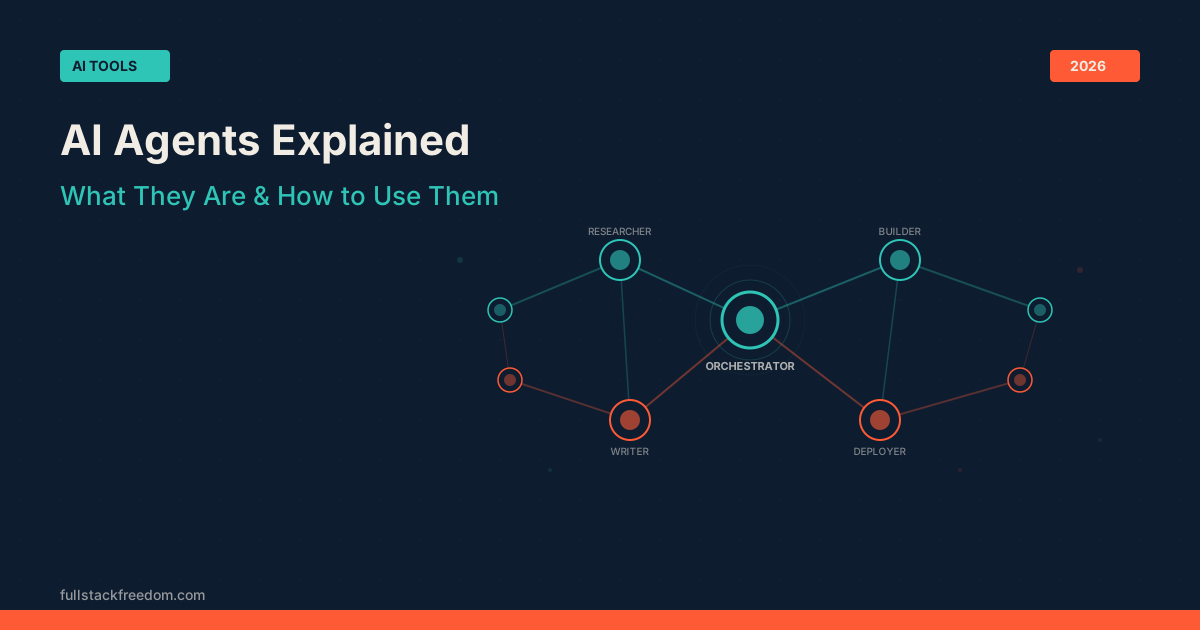
| CrewAI | Multi-agent orchestration | Open-source framework for teams of agents that collaborate on complex tasks |
I use Claude Code and Lovable every single day. Claude Code agents handle everything from writing blog posts (yes, including the SEO-optimized structure) to deploying full features on this website. Lovable is my go-to when I need to spin up a working app in hours instead of weeks.
How AI Agents Actually Work (No PhD Required)
The technical explanation involves LLMs, tool calling, and reasoning chains. But here’s the version that actually matters if you’re running a business.
Think of an agent like a sharp intern with superpowers. You give them a goal. They figure out the steps. They have access to your tools. They come back with results, and if something breaks, they try to fix it before bothering you.
The core loop looks like this:
- Perceive. Read the current state (files, data, context).
- Plan. Decide what steps to take.
- Act. Use tools to execute (write code, call APIs, generate content).
- Evaluate. Check if the output is right.
- Iterate. If not, adjust and try again.
This is why MIT Sloan calls agentic AI a shift from AI as a tool to AI as a collaborator. The agent doesn’t wait for your next instruction. It figures out what the next instruction should be.
Real Use Cases for Founders and Operators
Forget the enterprise case studies about JPMorgan and Walmart. Here’s what AI agents look like when you’re running a lean operation:
Content Operations
This is where I live. My publishing workflow uses Claude Code agents to:
- Generate SEO-optimized blog posts with proper frontmatter and internal linking
- Create YouTube descriptions, titles, and timestamps from video transcripts
- Maintain consistent brand voice across dozens of posts
The agent has my style guide, my link library, and my content templates baked in. I review and approve. I don’t write from scratch every time. I took this further and built an AI Chief of Staff with Claude Code that manages tasks, priorities, and daily operations alongside content production. If you’re building out your own content production stack, the best AI content creation tools post covers the specific tools I pair with these agent workflows.
Building Products Without a Dev Team
I built the website you’re reading this on with Claude Code agents. Not “I used AI to help me code.” I mean: the agent wrote the components, set up the routing, generated the content, and deployed it. I directed the work. Like building a website with AI and no CMS. That’s a real workflow, not a hypothetical.
With Lovable, I’ve shipped client-facing apps in a fraction of the time it would take to hire and manage a developer. Describe the app, review the build, deploy.
Marketing Automation
AI agents are starting to handle what used to require a full marketing automation platform. Lead scoring, follow-up sequences, content personalization. Agents can orchestrate these workflows dynamically instead of through rigid if/then rules.
The difference: traditional automation does exactly what you program. An agent adapts based on context. A follow-up email that adjusts its tone based on how the prospect interacted with your last three touchpoints? That’s agentic.
Customer Support and Operations
Tools like Lindy and Intercom’s Fin aren’t just answering FAQs anymore. They’re processing refunds, updating orders, routing complex issues, and resolving problems without a human in the loop. For a small team, that’s the equivalent of hiring three support reps.
What Agents Can’t Do (Yet)
I’d be doing you a disservice if I didn’t mention the limitations. Agents are powerful, but they’re not magic:
- They hallucinate. Agents can confidently execute the wrong plan. You still need review checkpoints.
- They struggle with ambiguity. Clear goals with defined success criteria work best. Vague “make it better” instructions produce vague results.
- They don’t replace judgment. An agent can execute a marketing campaign. It can’t tell you whether that campaign aligns with your brand strategy.
- Cost adds up. Running agents at scale means token costs, API fees, and compute time. Budget accordingly.
The founders getting the most value from agents aren’t the ones automating everything. They’re the ones who know which tasks to delegate and which to keep.
How to Start Using AI Agents This Week
You don’t need to build a multi-agent orchestration framework. Start small:
- Pick one repeatable workflow. Content creation, code review, data entry, customer responses.
- Try Claude Code or Lovable first. Both have free tiers, both are genuinely agentic, both work out of the box.
- Give the agent clear context. The more it knows about your business, voice, and standards, the better it performs. If you’re coming from ChatGPT, you can transfer your ChatGPT memory to Claude so it knows who you are from day one.
- Review outputs carefully at first. Trust builds as you learn what the agent handles well vs. where it needs guardrails.
- Expand gradually. Once one workflow is solid, add the next.
This is exactly how I built my content operation. One workflow at a time. Now it handles tasks that would require a small team, and the bottleneck is my review time, not production capacity.
What This Means for You
AI agents aren’t coming. They’re here. The question isn’t whether they’ll change how small teams operate. It’s whether you’ll be one of the early ones who figures out how to use them, or one of the late ones playing catch-up.
The all-in-one tool stacks that founders have relied on are being augmented (and in some cases replaced) by AI agents that are more flexible, more adaptive, and increasingly more capable.
My advice: don’t wait for the perfect agent to arrive. Start building with the ones that exist today. The skill you’re developing isn’t “using Tool X.” It’s learning how to delegate to AI effectively. That skill compounds regardless of which tools win.
Wrapping Up
The gap between founders who adopt AI agents early and those who wait is going to widen fast. Not because the technology is complicated, but because the people using it are building compounding advantages in speed, output, and capability.
If you want to see exactly how I’m using AI agents to build, publish, and grow (including the prompts, templates, and workflows), come hang out in the Full Stack Freedom community on Skool. It’s free to join, and it’s where I share everything I’m building in real time.
The tools are ready. The question is whether you are.