Every founder I talk to right now knows they need an AI business strategy. The problem isn’t awareness. It’s knowing where to start. Most of the advice floating around is written for enterprise teams with dedicated AI departments and six-figure budgets, which is completely useless if you’re running a lean operation.
I’ve mentored over 200 founders through Techstars and other accelerator programs, led an agency to exit, and now I’m building my entire business on AI agents. So I’ve seen what works and what doesn’t, not from reading reports, but from watching real businesses try to figure this out in real time.
Here’s the thing: you don’t need a 50-page AI transformation document. You need a clear framework, a starting point, and the discipline to not chase every shiny tool that shows up in your feed.
Start With Your Bottleneck, Not the Technology
The biggest mistake I see founders make with AI adoption is starting with the tool. They hear about a new platform, sign up for the free trial, play with it for a week, and then forget about it because it didn’t solve an actual problem.
Flip the order. Start by identifying what’s actually slowing your business down right now.
Ask yourself three questions:
- What task eats up most of my time every week?
- What am I avoiding because it’s tedious or repetitive?
- Where do things break down when I’m not personally involved?
Those answers are your AI strategy. Not some abstract roadmap. Real bottlenecks that cost you time, money, or both.
One founder I worked with was spending 8 hours a week writing follow-up emails to leads. Another was manually creating social media posts from scratch every day. A third was doing all their client reporting in spreadsheets. Each of those is a clear automation target. None of them needed a “digital transformation initiative” to fix.
The Three Layers of AI Adoption
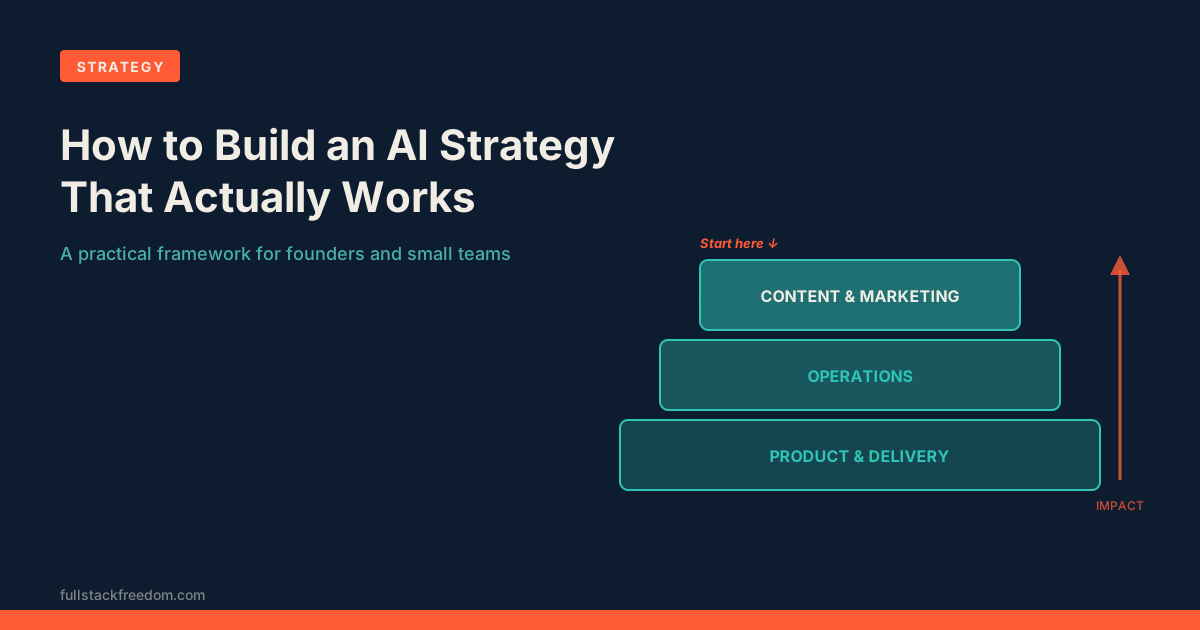
When I help founders think about their AI implementation strategy, I break it into three layers. Not because you need all three at once, but because it helps you see where you are and where the next opportunity sits.
Layer 1: Content and Marketing
This is where most founders should start. It’s the lowest risk, fastest payoff, and easiest to test.
- Writing and repurposing content (blog posts, emails, social)
- Generating ideas and outlines
- Editing and refining copy
- Building simple landing pages and marketing assets
Tools like Claude handle the writing and thinking side. GoHighLevel automates email sequences, SMS follow-ups, and pipeline management. You can go from “I should probably send a newsletter” to a fully automated content pipeline in a weekend. For a deeper look at how generative AI applies across business functions beyond marketing, see the top generative AI use cases for business.
Layer 2: Operations
Once your marketing is humming, look inward. Operations is where AI saves you from the death-by-a-thousand-cuts tasks that eat your day.
- Client onboarding workflows
- Scheduling and calendar management
- Data entry and CRM updates
- Invoice generation and follow-ups
- Internal reporting
This layer usually requires connecting tools together: a CRM that triggers automations, an AI assistant that drafts responses, workflows that run without you babysitting them. The best AI business solutions here aren’t flashy. They’re invisible, running in the background while you focus on growth. For a practical example, see how I built an AI Chief of Staff with Claude Code to handle task management and daily prioritization automatically.
Layer 3: Product and Service Delivery
This is the advanced layer. You’re building AI into what you actually sell.
- AI-powered dashboards or reports for clients
- Automated analysis or recommendations
- Custom tools built with AI for specific client needs
- AI agents that handle parts of your service delivery
I used Lovable to build internal tools and client-facing apps without writing code from scratch. When you reach this layer, AI isn’t just supporting your business; it’s part of your product. That’s a real competitive advantage, and it’s one most of your competitors aren’t thinking about yet.
What an AI Business Strategy Actually Looks Like
Forget the fancy strategy decks. Here’s the practical framework I walk founders through. Six steps, done in order.
-
Audit your current tools. List every piece of software you pay for and every manual process in your workflow. You can’t automate what you haven’t mapped. I covered how I rebuilt my entire site with AI tools in Building a Website with AI: No CMS Needed. That kind of audit is what kicked off the whole project.
-
Identify the manual work. Highlight anything that’s repetitive, time-consuming, or doesn’t require deep judgment. These are your automation candidates.
-
Pick one workflow. Not three. Not five. One. The goal is a quick win that builds confidence and teaches you how AI fits into your specific operation.
-
Automate it. Use the right tool for the job. Content tasks go to an AI writing assistant. Marketing automation goes to your CRM. Internal tools might need a no-code builder. Match the solution to the problem.
-
Measure the result. Track the before and after. How much time did it save? Did quality stay the same or improve? What broke? This data matters more than any case study you’ll find online.
-
Expand from there. Take what you learned and apply it to the next bottleneck. Each iteration gets faster because you understand your own workflow better.
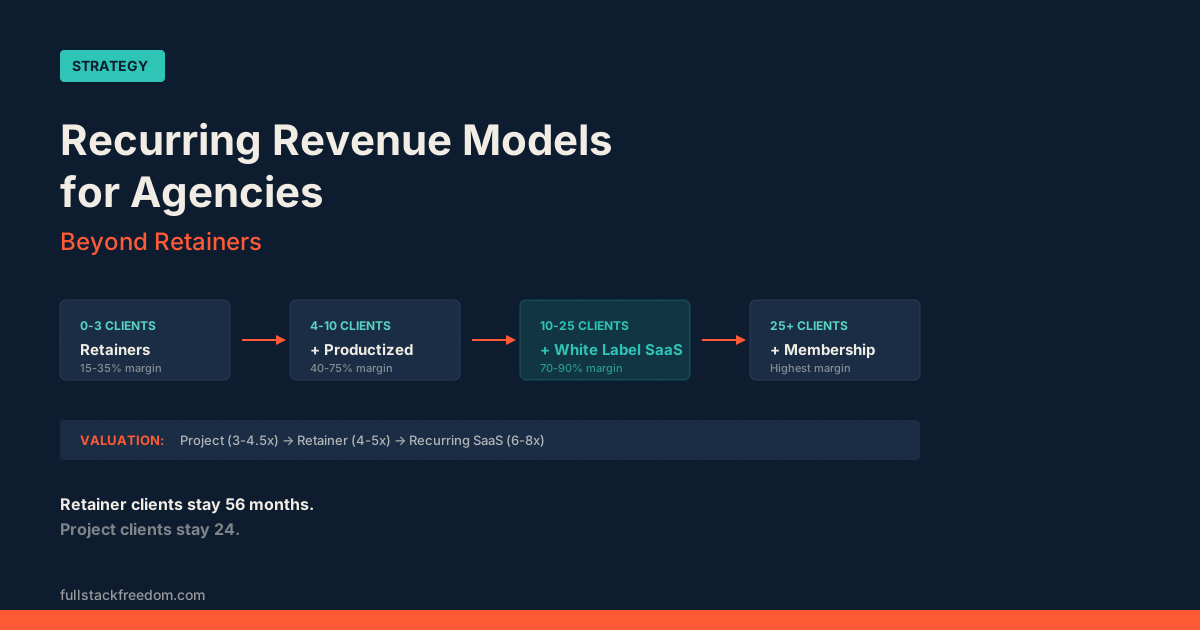
This is the same approach used to build recurring revenue models for agencies. Start simple, prove it works, then layer in complexity.
Tools That Make This Real
You don’t need 20 tools. You need a few that work well together. Here’s the stack I use and recommend to the founders I work with:
| Tool | What It Does | Layer |
|---|---|---|
| Claude | Content, code, strategy, analysis | 1, 2, 3 |
| GoHighLevel | CRM, email, SMS, pipeline automation | 1, 2 |
| Lovable | Build apps and tools with AI | 3 |
That’s the core. Three tools covering all three layers. You can see the full tool stack I recommend for agencies and operators if you want more detail, but start here.
The important part isn’t which tools you pick. It’s that you pick tools that solve problems you’ve already identified. If you haven’t done the audit and bottleneck mapping from the framework above, even the best tools won’t help.
What Most People Get Wrong About AI Strategy
After working with hundreds of founders on this, the failure patterns are predictable. Here are the three I see most often.
1. Chasing Shiny Tools
A new AI product launches every week. Most of them are wrappers around the same underlying models, repackaged with different branding. If your strategy is “try every new tool,” your strategy is chaos.
Pick your stack, go deep on it, and ignore the noise for 90 days. You’ll learn more in three months of focused usage than a year of tool-hopping.
2. Trying to Automate Everything at Once
The founder who tries to implement AI across marketing, operations, and product delivery simultaneously is the founder who burns out and gives up. I’ve seen it happen dozens of times.
Sequence matters. Start with one layer, one workflow, one tool. Get that working before you expand. The framework exists for a reason. Building an AI implementation plan for a subscription business works the same way. Layer by layer.
3. Not Measuring Results
“It feels faster” isn’t a metric. If you can’t say “this saved me 6 hours a week” or “response time dropped from 24 hours to 2 hours,” you don’t actually know if your AI strategy is working.
Track three things:
- Time saved per week on automated tasks
- Quality of the output compared to the manual version
- Cost: what you’re paying for tools versus what you were paying in labor
Without measurement, you’re just collecting subscriptions.
What This Means for You
If you’re a founder or small team operator, the good news is that an AI business strategy doesn’t need to be complicated. The bad news is that nobody else can build it for you. It has to be shaped around your specific bottlenecks, your workflow, and your goals.
The founders who are winning right now aren’t the ones with the most tools or the biggest AI budgets. They’re the ones who picked a real problem, found a tool that solved it, measured the result, and moved on to the next one. That’s the whole playbook.
You don’t need permission to start. You don’t need a consultant or a task force. You need 30 minutes to map your workflows, one tool to test, and the willingness to iterate.
Where to Go From Here
I’ve been sharing the exact workflows, prompts, and automation setups I use across my business inside the Full Stack Freedom community on Skool. If you want the templates behind this framework (the audit spreadsheet, the tool evaluation criteria, the weekly tracking sheet), that’s where they live.
The best AI strategy is the one you actually execute. Start with one bottleneck this week. Just one. You’ll be surprised how quickly the dominoes start falling.